I don't make everything political. It already is.
I've followed politics for my entire adult life, and it started in my youth. But I tend to turn conversations to politics not because I love politics, which people mistakenly assume. Let me explain.
It’s true that I’ve followed politics more deeply than most people for decades. Most people despise politics because it always smacks of hidden agendas and self service. Yet I’ve always believed that it is my duty to know as much as I can about what’s going on in America, because America purports to be self-governing. But we all know that lying politicians frequently do NOT govern in the best interest of their electorate, but often just protect their own self-interest. And they do this by lining their own pockets and the pockets of their allies.
While other people tune out political news thinking it’s all just “party politics,” or ideological conversations that smack of “left vs. right,” or geopolitics (questions of which countries should exist and where should their borders be, or which wars should be fought), I often read up on (and talk about) the historical and ideological context of the situation at hand. And therefore, people mistakenly think that “Kevin loves politics.”
That couldn’t be further from the truth. I do actually want to be up to speed on what’s really happening, and I’m passionate about wanting others to do the same. But that is because I’m a truth seeker at heart. An electorate informed of the truth is the only way we keep freedom. As Reagan once said, “Freedom is never more than one generation away from extinction.”
I try to be a lifetime learner. Not because I love every subject matter I want to know something about. I actually despise what I know about the often corrupt nature of the world, the country, the economy, healthcare, and the cultural environment we live in. But politics is a fact of life, and as we know, facts don’t care about our feelings.
At a recent family dinner, one of my daughters joked to her youngest sister “be careful, because Dad can turn any subject to politics.” To which my youngest replied something to the effect of “well, let’s find out.” So she turned to me and said “Dad, if we are talking about bananas, how would you turn that conversation to politics?”
To my credit as a dad, I think, I didn’t choose to bore her with a long dissertation on world trade and how we get bananas into our local grocery stores. I wanted to, no doubt. But I instead had a quick and poignant response from pop culture.
Remy, a musical artist with libertarian political leanings, wrote and performed a parody song based on the popular song “Havana.” The parody is called—wait for it—”Banana.” It’s a funny song, but makes a legitimate point, that nearly every subject or undertaking in life involves politics. Even bananas. Here is the song:
The reality, not just for me, but for everyone in this world we live in, is that politics touches every aspect of our lives. If there is something we enjoy or believe in that requires multiple human beings to collaborate in order to pull off, I guarantee that there are politics involved.
Some of the areas of life that are, for better or worse, heavily shaped by political considerations, are:
Candidates for public office (obviously)
Which kinds of products get subsidized or penalized when brought into America.
Which companies get the subsidization or penalty for bringing a particular product into America.
Which stories are trending this week on social media.
How trending stories are tapped into (using content and hashtags) by candidates, companies, or industries with financial ties to a particular product or trend.
Which trending stories are used by leaders of various factions of various faith groups.
Who is selected by a denomination to lead that denomination—or speak on its behalf.
Which topics are selected (or avoided) in the sermon at each gathering of a denomination, faction, or congregation thereof.
Which topics are selected (or avoided) at the dinner table at home—not just on Thanksgiving, but every night.
This is not an exhaustive list, of course. But it raises the question “what do you define as ‘political’?” What exactly does “political” mean? Here’s what I mean.
Most dictionaries don’t give a really accurate definition of the word “political,” mistakenly focusing only on the governmental aspect of it. But that’s not how I use it in this article, nor should you in your daily life. Politics does not just mean governmental things.
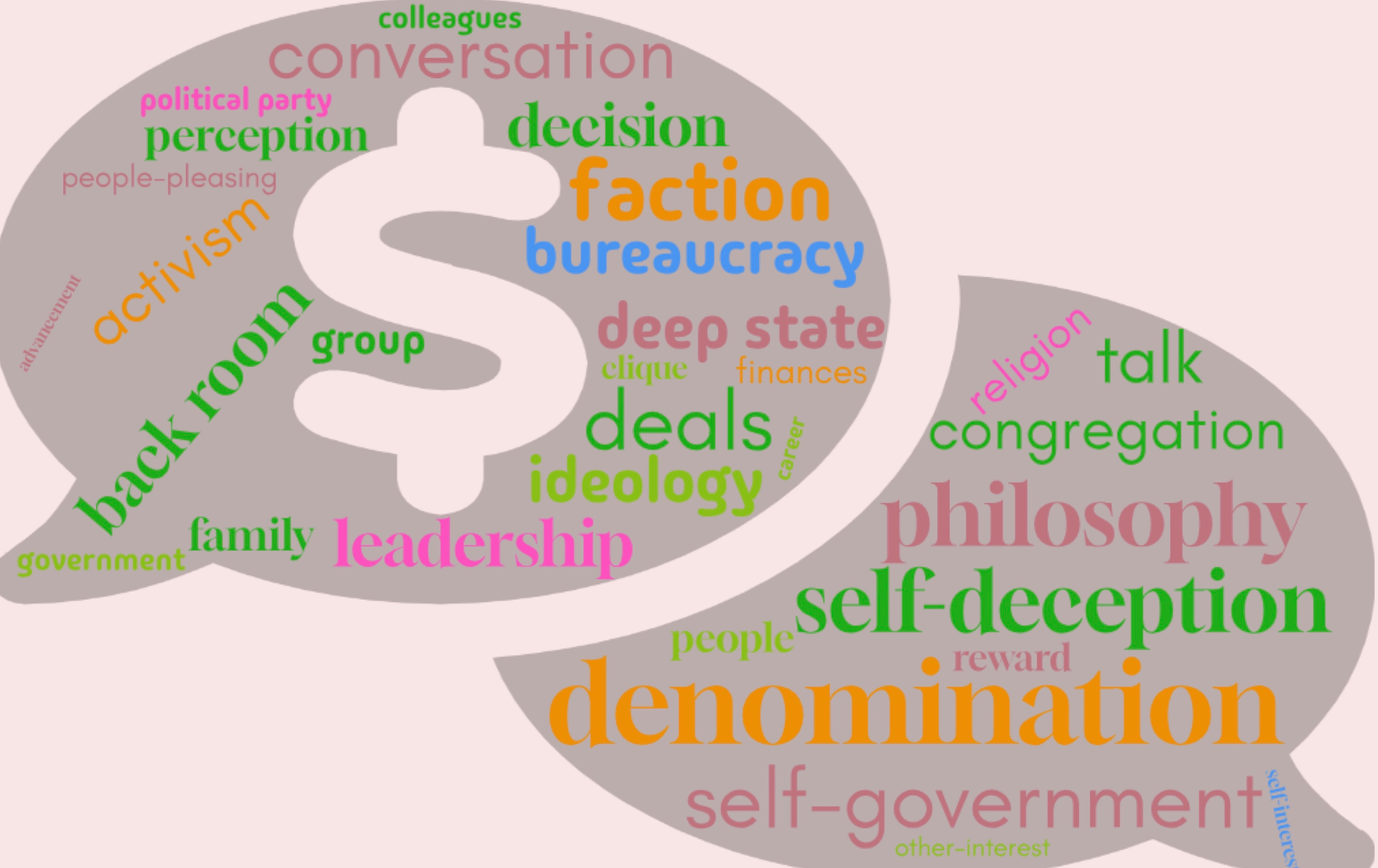
Politics is simply a social dynamic of decision-making in any aspect of life, not necessarily anything to do with government. A denomination deciding who will lead it can be a highly political process, not because it has anything to do with government, or even left vs. right, but because it involves groups of people. There is the group of people in official or lay leadership who want (or don’t want) a certain candidate for official leadership. Then there is the group of people making up the membership of the denomination or faction.
The group of people advocating for against a particular leader, are very much thinking about what the larger group of people might think about that leader. Further, they are likely thinking deeply about what the general public might think about that choice of leaders. Still further, those vocal advocates for a particular leader are likely thinking about what members, and the general public, might think about their advocacy for that particular leader—and how their advocacy might affect their own role or advancement, either in that denomination or even in their secular career.
These are all political considerations. And they have nothing to do with party politics, or left vs. right. They have to do with interpersonal relationships among groups, interpersonal perceptions, and ultimately, decision-making. THAT is why I say that every facet of life involves politics, for better or worse. Because every facet of life, including who grows bananas and successfully gets them to your local grocery store, involves politics. And not necessarily governmental.
That is because every human being cares to some extent about how a larger group of people might perceive them, or does actually perceive them. That certainly shouldn’t be the only consideration in our decision-making. We should never only be thinking about doing what other people want us to do. That is “people-pleasing” which is purely political, and very crass.
But being aware of the social implications of a decision can not always be dismissed as mere “people-pleasing.” It can also mean wisdom in achieving a larger end.
For instance, if I make a meal that is heavy on spiciness, which pleases me but few others in my family, it would be relationally poor judgment to make that for them. And a relational judgment about that decision has a political component to it, because I want to please my family. If I’m going to be asking them to do something later, perhaps watching a show that I’m excited about seeing, then it probably wouldn’t be relationally—or politically—smart to make them a dinner I know they won’t appreciate. Maybe a high-carb pizza is good after all. Is that crass or too political or self-serving? No, it’s the loving thing to do. And the loving thing to do would be to NOT expect them to watch the show I’m excited about if I know they probably are not interested.
What I’m getting at is that politics is necessarily a part of all decisions that involve groups of human beings. We are mistaken to think that fact-based pursuits like scientific research is unaffected by politics. “But, it’s science, Kevin. Science is about facts.”
Yes, ideally. But think about this: Which universities and research groups got funding for particular types of research because there were expectations attached to the line of research or the conclusions that would be published? And which medical journals published such research if the conclusions would against the financial and political interests of the groups of scientists, publishers, school administrators, grant writers, and grant review boards involved in the related topic?
Ah, yes—even academic research is plagued by political decisions—meaning decisions of groups that face complex interpersonal group dynamics. How about the decision about which pharmaceutical companies develop which drugs to address politically swayed research? Yes, that is largely political (and financial, of course). They have boards to answer to: CEOs, investors, and regulators.
So to conclude, when I comment over the dinner table that everything from AIDS research to cancer research is flawed by big Pharma and other interest groups, that is NOT me turning the subject of academics and scientific research to politics. I didn’t turn the conversation to politics. I just pointed out that it was already there. Don’t blame me for that!


